
Strategies to Manage a Concentrated Stock Position and Diversify Your Portfolio

For many investors, a concentrated stock position starts as a success story: equity compensation, an early stake in a high-growth company, or a stock that has appreciated substantially. Yet what starts smart can later pose a significant risk to your portfolio, net worth, and financial plan.
At New England Private Wealth Advisors, LLC, we work with professionals, executives, business owners, and other individuals with large positions in highly appreciated stocks who face this challenge every day. If a single stock position represents a large portion of your portfolio, careful planning can turn potential risk into long-term opportunity.
What Defines a Concentrated Stock Position?
A concentrated stock position is a single stock that makes up a significant share of your portfolio or net worth. Most advisors consider any single position to be concentrated once it exceeds 10%–20% of your investment portfolio.
Concentrated positions are often the result of:
● Employer equity compensation (RSUs, options, restricted stock)
● Early investment in a company that has grown significantly
● Inheritance or gifts of appreciated stock
● Long-term holding of a successful single investment
There are many reasons – psychological, financial, strategic, and sometimes even accidental – an investor may have a significant portion of their portfolio invested in a single asset. But, concentrated positions carry idiosyncratic risks that may have outsized impacts on the portfolio.
For example, if you’re heavily invested in one company (e.g., the company you work for), your portfolio may be exposed to risks tied to that business alone:
● A change in leadership
● A product recall
● A lawsuit or regulatory issue
● A missed earnings report
● Negative press
These are unpredictable events unique to that company. Unlike systemic risk (interest rate changes, recessions, geopolitical events, etc.) which diversification can help soften, this idiosyncratic risk cannot be offset simply by holding other types of stocks, because in a concentrated position, you might not hold much else.
A closer Look at The Risks of a Concentrated Stock Position
A study by J.P. Morgan found that over a 40-year period, nearly 42% of individual stocks in the Russell 3000 suffered an absolute negative return. A concentrated position in a single stock underperformed a diversified position in the Russell 3000 66% of the time. Even strong-performing stocks often underperform the broad market over time.
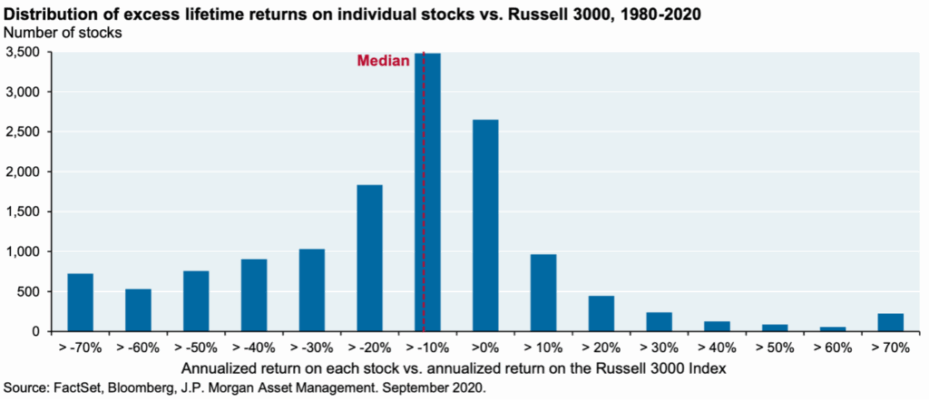
In contrast, a diversified portfolio, spanning sectors, industries, and asset classes, helps distribute the risk that concentrated holdings introduce. If one holding falls, others may hold or rise. Concentrated portfolios lack appropriate diversification which is why they pose a significant risk.
Diversification can help smooth returns by spreading risk and improving the chances of participating in the growth of the best-performing stocks over time. In contrast, relying on a single stock introduces far more volatility and downside exposure without the built-in resilience that comes from spreading risk across sectors and companies.
Here’s why concentrated positions pose such a significant risk:
Idiosyncratic Risk: A concentrated position exposes you to company-specific events such as leadership changes, lawsuits, or product failures that can erase years of gains overnight.
Market Risk: While market risk is inherent in all investments, regardless of level of diversification, concentrated positions can amplify those risks. With your portfolio heavily tied to the price of one stock, any downturn in that company can disproportionately impact your financial future.
Liquidity Constraints: Equity compensation, such as RSUs or restricted stock, often comes with sale restrictions, making it difficult to rebalance or sell when markets turn volatile.
Tax Exposure: Selling a large position can trigger substantial capital gains taxes, potentially pushing your adjusted gross income higher and increasing your overall tax burden.
Why Investors Hold on to Concentrated Positions
Many investors with concentrated positions are hesitant to diversify. Reasons may include:
-
- Emotional attachment: You believe in the company, helped build it, or still work there.
- Tax concerns: Selling may trigger a high capital gain and increase your income tax or adjusted gross income.
- Past performance: It’s tempting to hold onto what has worked.
- Lack of awareness: Some investors don’t realize just how much risk they’re carrying.
Whatever the reason, holding too much of one security may expose you to unnecessary risk. Fortunately, there are ways to diversify a concentrated position without sacrificing growth or control.
Strategies for Managing a Concentrated Stock Position
Reducing concentration strengthens flexibility, improves tax efficiency, and lowers risk. Reducing concentration may strengthen flexibility, improve tax efficiency, and reduce risk.
1. Gradual Diversification Over Time
A common approach to reducing concentration risk in stock holdings is incremental sales spread over multiple tax years. This helps to:
-
- Reduce tax exposure by gradually managing realized capital gains and offsetting them with tax loss harvesting(when possible).
- Lower annual impact on adjusted gross income, potentially keeping income in lower tax brackets
- Take advantage of market fluctuations to manage timing and risk
- Maintain ownership throughout the diversification process
There are many ways to approach this, and your advisor can help implement a custom strategy based on your financial condition and individual risk tolerances. At NEPWA, we often find two strategies particularly effective:
1. Direct Indexing
Instead of owning an index mutual fund or ETF, an investor can open a direct indexing account. These accounts seek to mirror the performance and risk profile of an index, such as the S&P 500, by directly holding a carefully weighted portfolio of the index’s individual stocks.
A key advantage to this type of approach, rather than purchasing an index fund equivalent, is the ability to harvest losses at the individual stock level. Realized capital losses from selected holdings can create a valuable tax asset, which may then be strategically used to offset capital gains from the sale of a business, a concentrated stock position, or other appreciated assets.
2. Tax-Aware Long/Short Strategies
Tax-aware long/short strategies use both long and short stock positions to build a diversified portfolio focused on improving after-tax returns. These approaches introduce added complexity such as leverage, short positions, and a higher tracking error compared to direct indexing.
However, they can also deliver greater potential pre-tax outperformance and more persistent tax benefits. Like direct indexing, these strategies can capture realized losses in individual stocks, creating tax assets that may be used to offset future capital gains.
Both Direct Indexing and Tax-Aware Long/Short Strategies offer flexibility in the account funding source. This could be cash, in-kind security transfers, or a combination of both.
2. Charitable Giving Strategies
If you have appreciated stock, giving a portion of it to charity may offer a tax deduction while helping you reduce exposure.
Charitable Remainder Trust (CRT)
A Charitable Remainder Trust allows you to transfer appreciated assets, such as stock, into an irrevocable trust. The CRT can sell the stock without paying immediate capital gains tax, preserving more of your investment for future growth.
In return, you or another beneficiary receives an income stream for a set term or life. The payment amount depends on the trust type: a Charitable Remainder Annuity Trust (CRAT) pays a fixed amount annually, while a Charitable Remainder Unitrust (CRUT) pays a variable amount based on the trust’s value and investment performance.
Note that although the CRT itself is tax-exempt, the income distributed to the beneficiary is taxable and must be reported as ordinary income in the year it is received. Additionally, establishing a CRT provides an immediate charitable income tax deduction based on the present value of the remainder interest designated for charity. After the trust term ends — or upon the death of the income beneficiary — the remaining assets are transferred to the named charitable organization.This approach has practical income and tax advantages and may be of specific interest to those who are philanthropically inclined.
Donor-Advised Fund (DAF)
A Donor-Advised Fund is another versatile charitable giving tool. When you contribute “long-term” appreciated shares to a DAF, you receive a tax deduction at the time of the contribution based on the fair market value (FMV) of the stock. The tax deduction may be limited based on adjusted gross income (AGI). The DAF can then liquidate the holdings without immediate capital gains tax and invest the proceeds for future grants to selected charities.
This structure offers flexibility, enabling you to recommend grants over time rather than all at once, making it ideal for ongoing charitable strategies or long-term philanthropy. It can be especially beneficial to fund a DAF in a high-income year, such as after selling a concentrated stock position, to maximize your tax deduction.
Take Control of Your Portfolio. Book a Strategy Session
3. Exchange Funds
An exchange fund allows you to contribute a single stock position to a pooled fund of diversified assets. Over time, you receive a diversified portfolio in return, without immediately triggering taxes. Exchange funds may suit high-net-worth investors with large stock positions and long time horizons. They’re limited to publicly traded stocks and require minimum investments.
Exchange funds are a valid option for some, but investors should be aware of individual exchange fund fee structures and restrictive liquidity terms. A qualified financial advisor can help you understand the benefits and potential drawbacks of exchange funds and help determine if they’re right for you.
4. Hedging Strategies
If you cannot or prefer not to sell immediately, hedging strategies can help reduce risk.
Options Trading: Purchasing put options gives you the right to sell your shares at a fixed price, acting as insurance if the stock falls. Selling call options can provide additional income, but also limits future gains.
Equity Collars: By buying a put and selling a call simultaneously, you set both a floor (lower limit) and a ceiling (upper limit) for your stock’s value, often at low or no cost.
Prepaid Forward Contracts: These allow you to receive cash today by agreeing to deliver shares at a future date. This gives you liquidity and diversification without an immediate taxable sale.
Certain hedging strategies can also be paired with direct indexing and tax-aware long/short accounts to create a customized approach to strategically manage concentrated stock risk and tax-efficient sales.
Each approach has trade-offs in terms of cost, complexity, tax treatment, and impact on your portfolio. Carefully consider your goals and consult an advisor before implementing any strategy.
5. Use of Trusts
In addition to a CRT (mentioned above); a standard irrevocable trust may be a useful tool in managing concentrated positions.
Irrevocable trusts remove ownership of assets from your personal control, protecting from estate taxes and certain personal liabilities (creditors, lawsuits, and divorces, for example).
When a concentrated asset, such as a large stock position or inherited shares, is placed into an irrevocable trust, a trustee manages the assets on your behalf, and you no longer have control of the asset. The trustee can reinvest proceeds to diversify the portfolio and reduce concentration risk.
In most irrevocable trusts, selling concentrated holdings triggers capital gains tax at the trust’s tax rates. However, by making a gift during your lifetime to an irrevocable trust, any future appreciation of that gift will not be included in your taxable estate.
Unlike CRTs, irrevocable trusts generally do not generate an income stream for you or other beneficiaries; their main purpose is wealth preservation, diversification, and estate planning.
6. Strategic Gifting
Gifting appreciated stock to adult children or beneficiaries can be a tax-efficient way to reduce concentration while potentially lowering your family’s overall tax burden. Instead of selling the stock yourself—possibly at a high tax rate—you can gift the shares to a child in a lower tax bracket or in a state with no state income tax. The child can then sell the stock and pay capital gains tax at their potentially lower rate.
Note that the beneficiary inherits your original cost basis, so they will still owe capital gains tax on any appreciation since you acquired the shares. It is also important to be mindful of the “kiddie tax” rules for dependents, which can affect the taxation of investment income. This strategy is generally applied when gifting to adult children who are no longer dependents.
Working With a Financial Advisor to Manage a Concentrated Position
Every investor is unique. The most appropriate strategy depends on your goals, tax situation, income needs, and comfort with investment risk.
A qualified wealth advisor can:
-
- Identify the risks of concentrated stock positions
- Evaluate your full portfolio
- Recommend tailored diversification strategies
- Coordinate with tax and legal experts for optimal outcomes
It’s not only about protecting what you’ve built. It’s about unlocking flexibility, liquidity, and peace of mind.
A Smarter Way to Diversify Concentrated Holdings
A concentrated stock position can be a sign of past success, but if left unmanaged, it can expose you to unnecessary risk. By implementing the right strategies, you can unlock diversification and reduce that risk.”
At New England Private Wealth Advisors, we specialize in guiding clients through the complexities of managing concentrated stock positions. Whether you’re an executive with company stock, a founder with concentrated shares, or an investor navigating a high-stakes equity position, we can help you create a clear plan.
New England Private Wealth Advisors (“NEPWA”) is an SEC-registered investment adviser. Registration with the SEC does not imply a certain level of skill or training. The information provided herein is provided for informational purposes only. This communication is for general informational purposes only and is not intended to predict or guarantee the future performance of any individual security, market sector or the markets generally. NEPWA does not provide tax or legal advice and will act solely in its capacity as a registered investment adviser.
This communication may contain links to other websites, including links to the websites of companies that provide third-party rankings. Such external Internet addresses contain information created, published, maintained, or otherwise posted by institutions or organizations independent of NEPWA. These links are solely for the convenience of visitors to this Site, and the inclusion of such links does not necessarily imply an affiliation, sponsorship or endorsement.