
The One Big Beautiful Bill Act: What High-Net-Worth Families Should Know in 2026

In July 2025, Congress passed the One Big Beautiful Bill Act (OBBBA), a sweeping piece of legislation that extends and reshapes many provisions originally introduced under the 2017 Tax Cuts and Jobs Act. While the bill spans more than 800 pages, its real significance lies in how it may affect long-term planning decisions for families, retirees, and business owners.
Below is a high-level overview of several provisions that we feel are most relevant for high-net-worth households, and why they may warrant a closer look as part of a coordinated wealth strategy.
1. Tax Rates and Deductions: Stability (For Now)
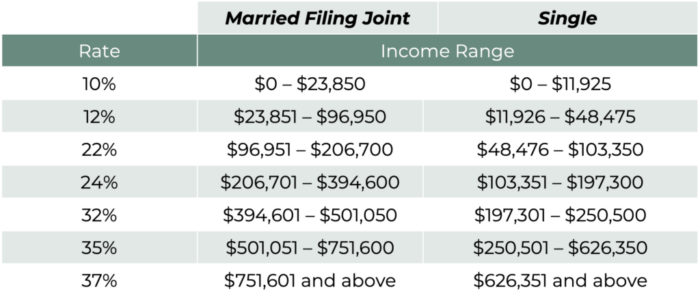
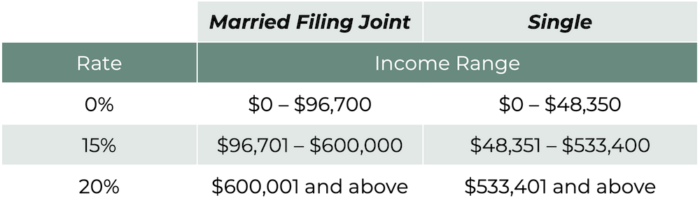
One of the most notable outcomes of the bill is what didn’t happen. The current individual income tax brackets were previously scheduled to sunset in 2026 and are now permanent under current law. The top marginal rate remains 37%. The top long-term capital gains rates remain unchanged at 20%.
2025 Income Tax Brackets
2025 Capital Gains Tax Brackets
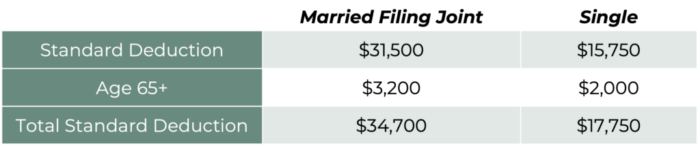
In addition, the higher standard deduction amounts are now permanent and indexed for inflation. For many households, this reinforces the importance of evaluating whether itemizing deductions still makes sense year to year, especially as other deduction rules evolve.
Standard Deduction
Planning implication: Greater rate stability can improve long-range cash-flow and withdrawal planning, but permanence does not mean immutability. These rules can still change with future legislation.
2. Expanded Senior Deductions (2025–2028)
For taxpayers aged 65 and older, the bill introduces a temporary “senior deduction” of up to $6,000 per individual (or $12,000 for qualifying married couples), subject to income phaseouts.
This deduction is available whether a taxpayer itemizes or takes the standard deduction and sits on top of existing age-based standard deduction increases.
Expanded Senior Deductions

Planning implication: For retirees within certain income ranges, this provision may temporarily reduce taxable income and affect distribution sequencing decisions from retirement accounts.
3. State and Local Tax (SALT) Deduction Expansion—Temporarily
From 2025 through 2029, the SALT deduction cap increases to up to $40,000 for households under specific income thresholds, before gradually phasing out and reverting to $10,000 in 2030.
SALT Deduction Expansion

Planning implication: The temporary nature of this provision reinforces the value of multi-year planning. Households with fluctuating income or liquidity events may benefit from coordinating deductions across tax years.
4. Estate and Gift Tax Exemptions Increase
Beginning in 2026, the estate and lifetime gift tax exclusion rises to $15 million per individual ($30 million for married couples), indexed for inflation.
Planning implication: While this expands planning flexibility for affluent families, it also raises important questions about timing, legacy objectives, and multigenerational wealth transfer, especially given how often estate tax rules change over time.
5. Charitable Giving Rules Are Shifting
The bill introduces new rules for charitable deductions:
- A modest above-the-line charitable deduction for standard deduction filers (beginning in 2026)
- Starting in 2026, for taxpayers who itemize their deductions, there are new limitation contributions that must exceed 0.5% of taxpayers AGI starting in 2026. It is our understanding that only the amount above the floor of 0.5% will be tax deductible.
Charitable Floor

Planning implication: These changes may affect how and when charitable gifts are structured, particularly for families who incorporate philanthropy into their broader wealth strategy.
6. Business Owners: QBI, Depreciation, and QSBS
Several provisions impact closely held business owners, including:
- Permanent extension of the Qualified Business Income (QBI) deduction
- Continued availability of bonus depreciation and Section 179 expensing
- Expanded gain exclusions for Qualified Small Business Stock (QSBS)
Planning implication: These rules can materially affect after-tax outcomes surrounding business income, reinvestment decisions, and eventual exit planning.
A Broader Takeaway
While headlines tend to focus on individual provisions, the real value comes from understanding how these rules interact with each other and with your broader financial picture. Income timing, retirement distributions, estate considerations, and business decisions rarely exist in isolation.
At NEPWA, we monitor legislative developments like the OBBBA to help ensure each client’s long-term plan remains aligned with their evolving goals and circumstances. We coordinate closely with clients’ tax and legal professionals to support informed, forward-looking decision-making.
Start the Conversation
If you’re wondering how recent tax law changes may fit into your broader wealth strategy, a thoughtful planning discussion can provide clarity, especially in periods of legislative transition.
Talk to an advisor about how the OBBBA may impact you.
New England Private Wealth Advisors (“NEPWA”) is an SEC-registered investment adviser. Registration with the SEC does not imply a certain level of skill or training. The information provided herein is provided for informational purposes only. This communication is for general informational purposes only and is not intended to predict or guarantee the future performance of any individual security, market sector or the markets generally. NEPWA does not provide tax or legal advice and will act solely in its capacity as a registered investment adviser.
This communication may contain links to other websites, including links to the websites of companies that provide third-party rankings. Such external Internet addresses contain information created, published, maintained, or otherwise posted by institutions or organizations independent of NEPWA. These links are solely for the convenience of visitors to this Site, and the inclusion of such links does not necessarily imply an affiliation, sponsorship or endorsement.